Create Your Soul Care Toolbox
By Jessica Isom, MD, MPH
Skip to the practiceLiberating yourself, in the ways you can, from injustice, past challenges, and unhealthy situations, is a key part of your soul care journey. To help yourself form daily habits that support your holistic mental health, grab a notebook, tablet, or other support tool to write about your experiences, needs, goals, and learning moments as you create your soul care toolbox.
Here are two tools you can develop, refine, and use to create the balance necessary for mindful justice that supports your emotional well-being and mental health.
1. Emotional Literacy: Understand What You're Feeling
Striving to increase your emotional literacy is a well-being practice that you can use in your daily life to navigate moments of emotional intensity with confidence. Emotional literacy is a skill you can develop over time to support your emotional awareness. All this means is that you begin to understand what you are feeling.
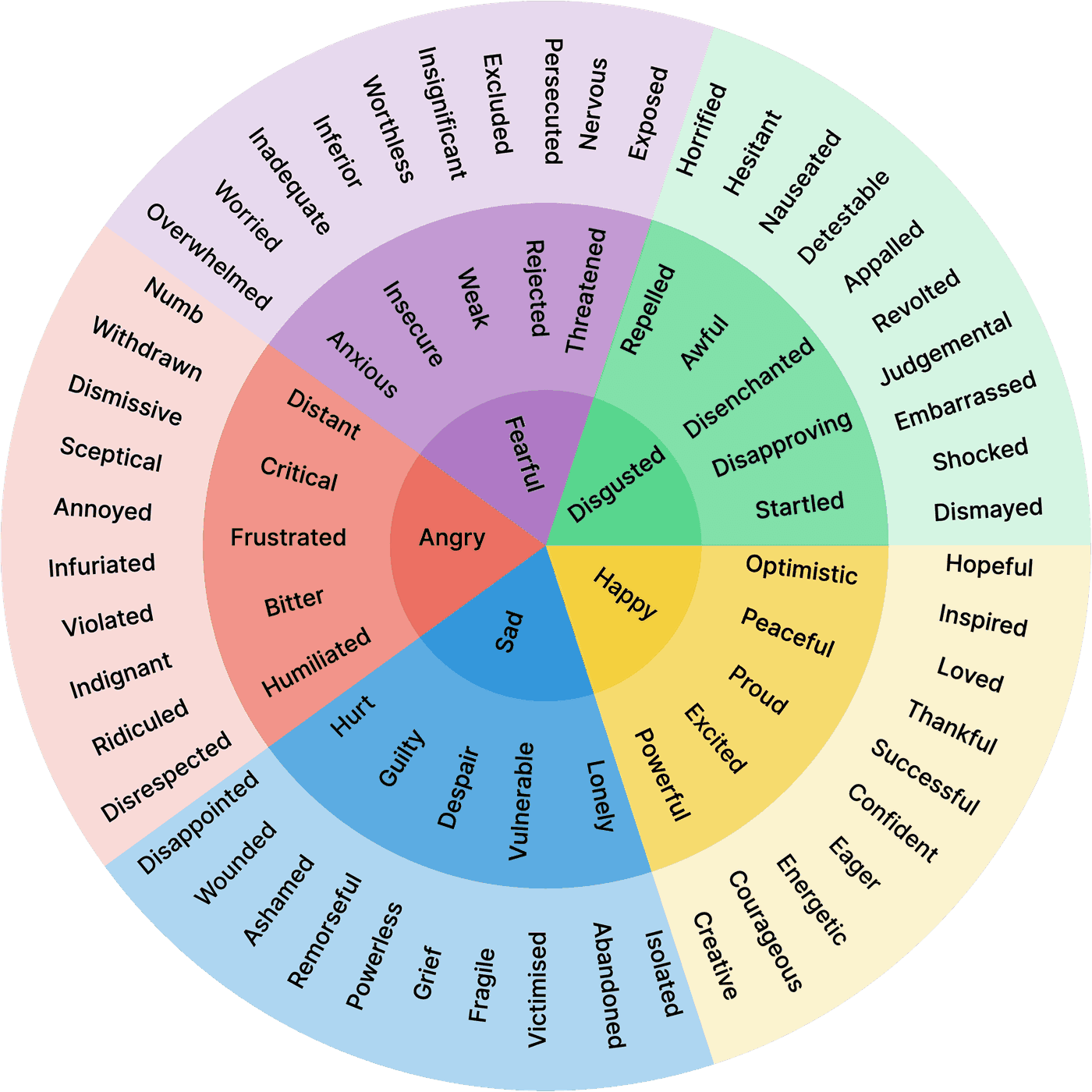
As a young person navigating a complex world, just existing can be a multifaceted experience with complex emotions and varied, sometimes limited, opportunities to fully articulate and express them. The feelings wheel is a great resource you can use to enhance your emotional awareness. It can also help you seek the support and resources you may need to respond to your emotional state.
As you recognize injustice and, at times, prepare for action in small and large ways, this tool allows you to identify and describe your emotions, validate your experience, and understand what is happening within your mind and body.
- Angry
- Distant, critical, frustrated, bitter, humiliated.
- Fearful
- Anxious, insecure, weak, rejected, threatened.
- Disgusted
- Repelled, awful, disenchanted, disapproving, startled.
- Happy
- Optimistic, peaceful, proud, excited, powerful.
- Sad
- Lonely, vulnerable, despair, guilty, hurt.
Assess your current skill set
Reflect on a recent intense emotional experience. Did you notice yourself taking a pause to name the emotions coming up for you? If you answered yes, during the pause did you have an easy time naming the emotions or did you find yourself struggling to articulate your experience? If you answered no, what was your first reaction to this emotional experience? Was this reaction useful to you or harmful to you? Use these answers to determine how much or how little practice you may need for this part of your toolbox.
2. Radical Acceptance: Let Yourself Accept Your Self
Radical acceptance involves acknowledging and accepting the reality of who you are or what a situation is without judgment or resistance. This practice helps reduce emotional suffering by allowing you to focus on what you can control and letting go of the struggle against what you cannot change.
This ability to accept ourselves has supported the emotional resilience of communities through many generations. Embracing radical acceptance fosters inner peace and resilience, essential for navigating life's challenges and sustaining your advocacy, activism and well-being efforts.
Like muscles in your body and neural pathways in your mind, gaining skills in this area is developed with time and intention. As you strengthen your ability to acknowledge and accept your reality for what it is, you will notice that you are able to move through adversity with more confidence and an empowered sense of self.
- Affirm your existence
- Use affirmations that reinforce acceptance, such as "I accept this moment as it is" or "I am at peace with what I cannot change."
- Let go
- Practice visualizing the release of resistance and control over the situation, allowing yourself to feel lighter and more at ease.
- Practice gratitude
- Focus on aspects of the situation or your life that you are grateful for, shifting your perspective to include positive moments or experiences in daily life.
- Be compassionate to yourself
- Be kind to yourself and acknowledge that it's okay to feel uncomfortable emotions without "fixing" them immediately.
- Practice acceptance statements
- Write down statements that reflect your acceptance of the situation, such as, "This is the way it is right now," or "I can handle this for now."
Keep a journal dedicated to your practice of radical acceptance.
Nothing you write here is saved on our servers. You can export a copy somewhere private to you.
If you’re in crisis: Text STEVE to 741741 to connect with a trained counselor 24/7. We are in this together, and help is always available.
However this landed for you, support is always here. Text STEVE to 741741 to connect with a trained counselor 24/7. We are in this together, and help is always available. You can also call 988.
Did this help?
This helps us improve the library. It isn't linked to you.
Sources
- Open Emotion Wheel v1.1.0.
- Torre, J. B., & Lieberman, M. D. (2018). Putting Feelings Into Words: Affect Labeling as Implicit Emotion Regulation. Emotion Review, 10(2), 116-124. doi:10.1177/1754073917742706
- All sources