Turn Toward Your Emotional Experience
By Jessica Isom, MD, MPH
Skip to the practiceWhen emotions show up, it is an invitation to understand yourself and your needs more fully. Your ability to sit with and welcome your emotional experience will grow your emotional courage over time.
This step involves being tender and curious about what is showing up. You will practise this skill by writing a compassion letter to someone other than yourself.
Watch: turning toward what you feel
Step 1: Name the feelings
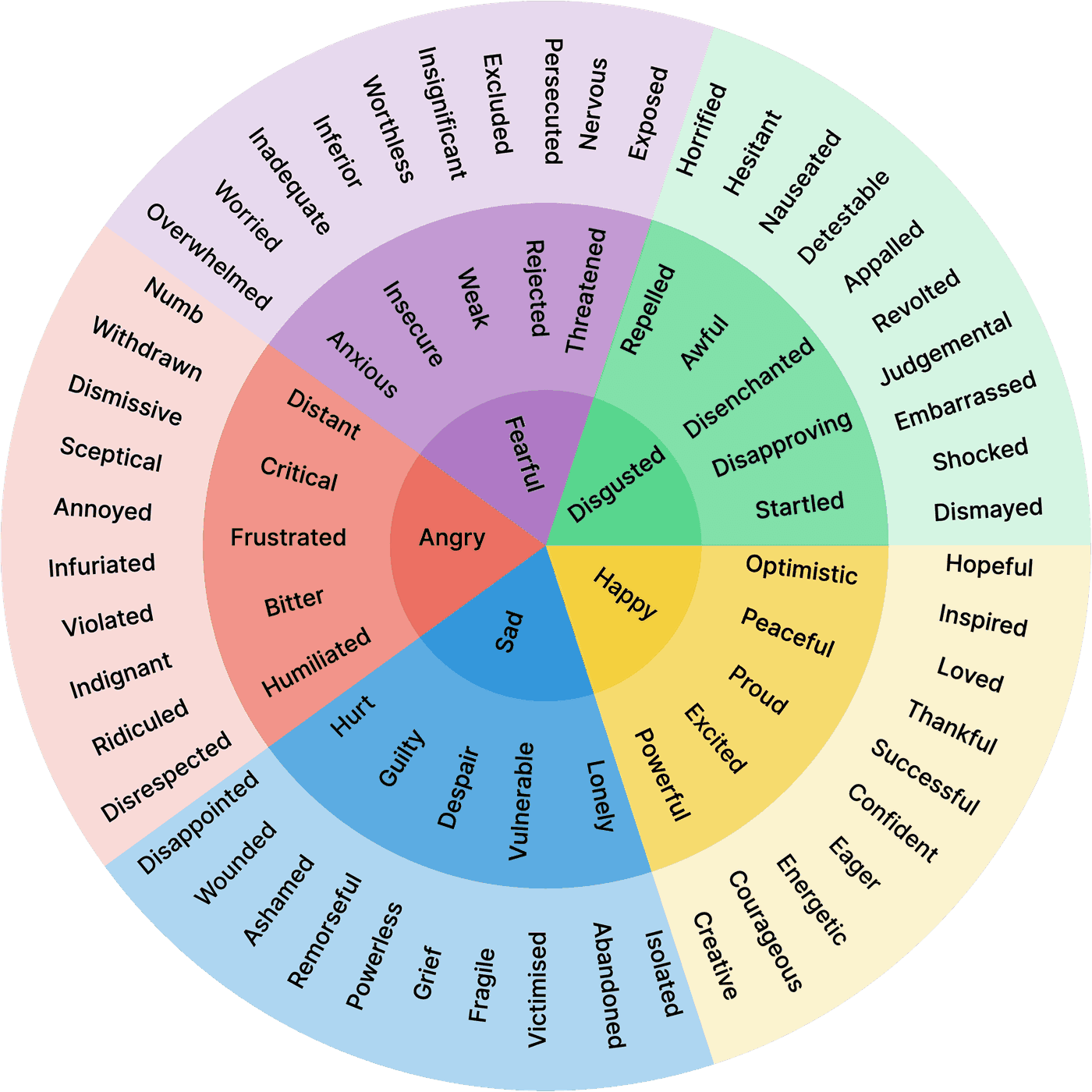
Spend some time reflecting on a recent moment where you felt overwhelmed by one or more feelings. If you need help naming them, use the wheel below for inspiration.
Nothing you write here is saved on our servers. You can export a copy somewhere private to you.
Close your eyes and spend a few moments visualising another person carrying the feelings you just described. You can picture someone close to you, or a stranger you have seen. Imagine what they look like, how they feel, and how these feelings are affecting them physically and mentally.
Step 2: Write a letter
Now, write a letter of compassion to this person. You can use the words that feel most natural to you.
Nothing you write here is saved on our servers. You can export a copy somewhere private to you.
Step 3: Reflect
Read back what you have written out loud. Once you are done, sit with one last question.
Nothing you write here is saved on our servers. You can export a copy somewhere private to you.
If you’re in crisis: Text STEVE to 741741 to connect with a trained counselor 24/7. We are in this together, and help is always available.
However this landed for you, support is always here. Text STEVE to 741741 to connect with a trained counselor 24/7. We are in this together, and help is always available. You can also call 988.
Did this help?
This helps us improve the library. It isn't linked to you.
Sources
- Open Emotion Wheel v1.1.0.
- Lynch, J. M., Stange, K. C., Dowrick, C., Getz, L., Meredith, P. J., Van Driel, M. L., Harris, M. G., Tillack, K., & Tapp, C. (2025). The sense of safety theoretical framework: A trauma-informed and healing-oriented approach for whole person care. Frontiers in Psychology, 15, 1441493. https://doi.org/10.3389/fpsyg.2024.1441493
- Midford, R., Nutton, G., Hyndman, B., & Silburn, S. (Eds.). (2020). Health and education interdependence: Thriving from birth to adulthood. Springer.
- Podolan, M., & Gelo, O. C. G. (2024). The role of safety in change-promoting therapeutic relationships: An integrative relational approach. Clinical Neuropsychiatry: Journal of Treatment Evaluation, 21(5), 403–417.
- All sources